

The Coherence Stack
Three Frameworks That Might Be Describing the Same Thing

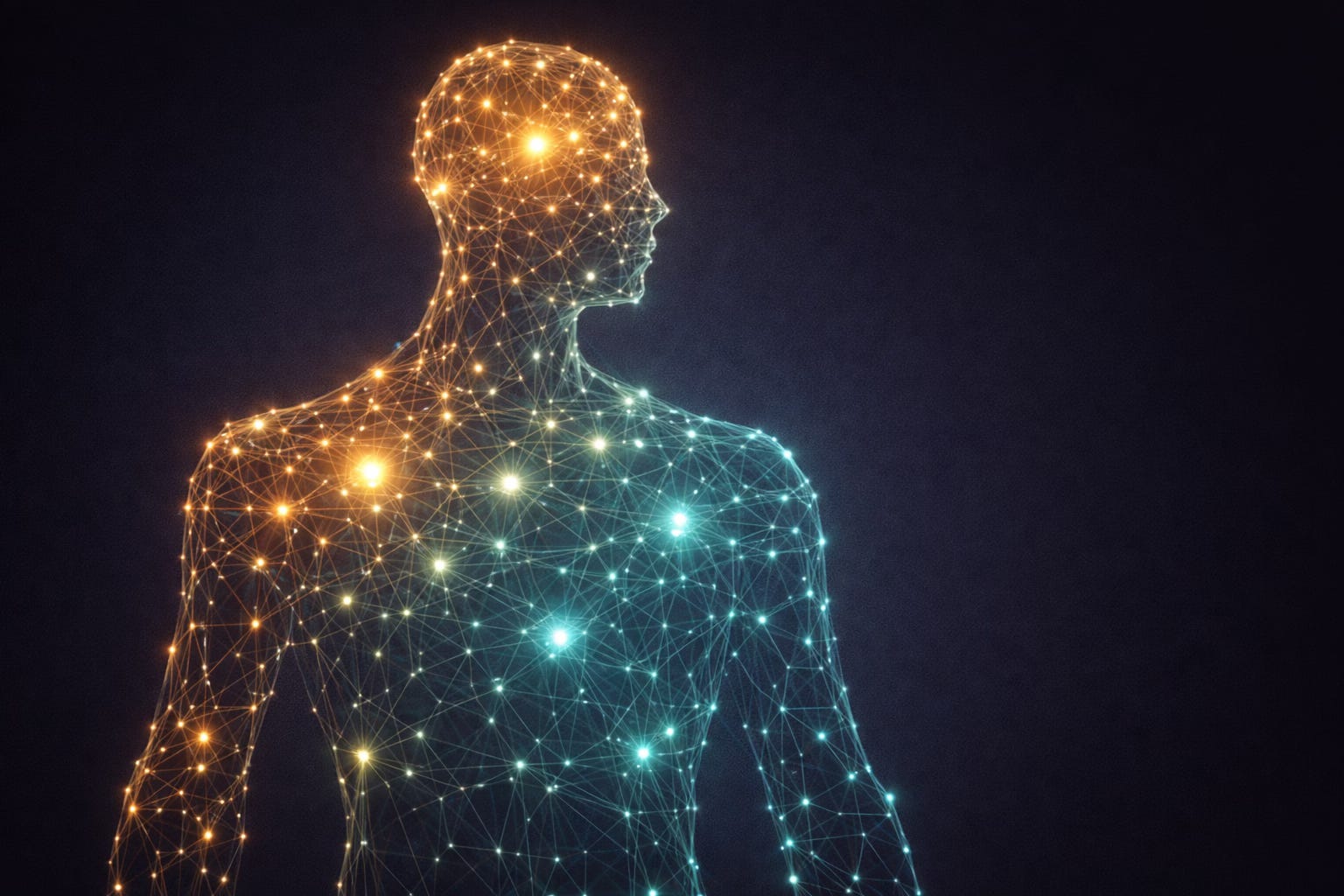
Three serious researchers, working in completely different fields, seem to be circling the same territory. None of them cite each other. None of them has named what they’re converging on. But the pattern is hard to ignore.
The Three Frameworks
Michael Levin runs a lab at Tufts studying bioelectricity. His team has shown that cells store information about body structure through electrical networks. Not neurons specifically, but cells generally. Cut a flatworm into pieces, and each piece “remembers” what shape to become. The cells know where they belong. Nobody’s quite sure how.
Levin calls the mechanism “opaque.” He can measure the bioelectric signals. He can manipulate them. But where the information actually lives? That’s still murky.
Roger Penrose and Stuart Hameroff have a different angle. They’re a physicist and an anesthesiologist who proposed that consciousness emerges from quantum effects in microtubules, the structural tubes inside cells. Their theory, Orch-OR, is controversial. A lot of neuroscientists dismiss it. But it’s serious physics, and it hasn’t been killed yet.
Here’s the detail that caught my attention: microtubules aren’t just in neurons. They’re in basically every cell in the human body.
Then there’s Iain McGilchrist, who wrote The Master and His Emissary about the brain’s hemispheres. His argument isn’t the pop-psychology “left brain = logic, right brain = creativity” thing. It’s subtler. He says the hemispheres differ in how they attend to reality. The right hemisphere perceives context, relationships, and the whole picture. The left hemisphere abstracts and sequences. Both are necessary, but fundamentally different modes of access.
Why This Matters Now
We’re in a strange moment for consciousness research. Neuroscience has mapped the brain in extraordinary detail, yet the hard problem remains untouched. We know which regions light up. We don’t know why there’s something it’s like to be you.
Meanwhile, AI systems are getting frighteningly good at mimicking cognition without anything resembling inner experience. That gap between functional intelligence and felt experience is widening, not closing. The tools keep improving. The explanations don’t.
That’s the context in which these three frameworks start to look interesting together. All three suggest the same thing: maybe we’ve been looking in the wrong place. Maybe the brain-as-computer metaphor, dominant for seventy years, isn’t just incomplete. Maybe it’s pointing at the wrong hardware entirely.
The Pattern
Levin shows memory distributed throughout the body, not just in the brain. But he can’t explain what’s actually holding the information.
Penrose and Hameroff propose a candidate: quantum states in microtubules. And microtubules are everywhere, not just neurons.
McGilchrist shows the right hemisphere accesses reality more directly, less filtered. The left hemisphere compresses things into sequences. But he’s talking about brain architecture, not whatever deeper layer both hemispheres might be reading from.
These three aren’t citing each other. Different fields, different journals, different conferences. But they seem to be describing the same architecture from different angles.
What the Stack Might Look Like
Think of it like a mesh network. Not the internet kind. The kind where every node holds part of the signal, and the whole system sustains the pattern together.
The deepest layer would be quantum states in microtubules, distributed across the entire body. This is where information would actually persist. Not as files in a folder, but as coherence patterns maintained across trillions of cells. Penrose-Hameroff territory extended beyond neurons.
Above that are bioelectric signals. These would be how the quantum patterns express themselves and propagate across cell networks. The electrical activity Levin measures wouldn’t be the memory. It would be the downstream expression. Like watching ripples to infer the stone.
The brain, then, isn’t a hard drive. It’s the densest node in the mesh, where you get enough microtubules packed together to read and write complicated patterns quickly. High bandwidth, not special storage.
And McGilchrist’s hemispheric differences? Different filters on the same underlying field. The right hemisphere reads more directly: messy, contextual, everything at once. The left hemisphere compresses the signal into something sequential and portable. Same source, different access patterns.
What This Would Explain
If any of this is close to right, a few things follow.
Memory wouldn’t be localized the way we usually think. The brain would be more like a high-traffic access point to a field that exists throughout the body. That would fit with Levin’s findings. He’s watching body memory that doesn’t require neural circuits.
It might also explain something about how people experience insight. That thing where you “see” a pattern before you can explain it, where the whole structure arrives before the words catch up. If that’s the right hemisphere tapping the field before the left hemisphere’s compression kicks in, the phenomenology makes sense.
And Levin’s “opaque mechanism” might have an answer. The reason he can measure bioelectric signals but can’t find where the information is stored might be because it’s stored in quantum states he’s not equipped to detect. He’s watching the shadow on the wall, not the thing casting it.
What Would Kill It
The weakest link is probably microtubules. If someone demonstrates they’re purely structural, with no quantum effects that could carry information, then the bottom falls out. That’s the load-bearing element. Penrose-Hameroff has survived thirty years of skepticism, but it’s still contested territory.
The bioelectric layer is on firmer ground. Levin’s work is reproducible and gaining traction. The question isn’t whether cells store information electrically. It’s whether that’s the whole story or just the readable surface of something deeper.
McGilchrist’s hemispheric model is the most established of the three, though also the furthest from neuroscience’s mainstream. His claims about attention and access patterns don’t require the quantum layer to be true. But they’re consistent with it.
The Gap
I don’t know why nobody’s connecting these frameworks explicitly. Maybe someone is, and I haven’t found them. Career incentives don’t reward cross-disciplinary speculation. Linking respectable bioelectricity work to Penrose-Hameroff, which still carries a whiff of “isn’t that a bit woo?”, probably isn’t great for grants.
But the convergence is hard to dismiss. Three researchers, three entry points, what looks like the same architecture, none of them has named.
If anyone with the right credentials is looking for a synthesis project, this might be it. The pieces are sitting there. Somebody just has to be willing to put them together and defend the result.
Maybe the body doesn’t store memories. Maybe it is one.
Tom Massey writes about cognition, AI, and systems thinking at The Dual Arc Project.