

The Conversation Code
For ages 7–12, a shared vocabulary helps children reflect on their day—so they can recognize growth, name difficulty, and begin forming a sense of self.

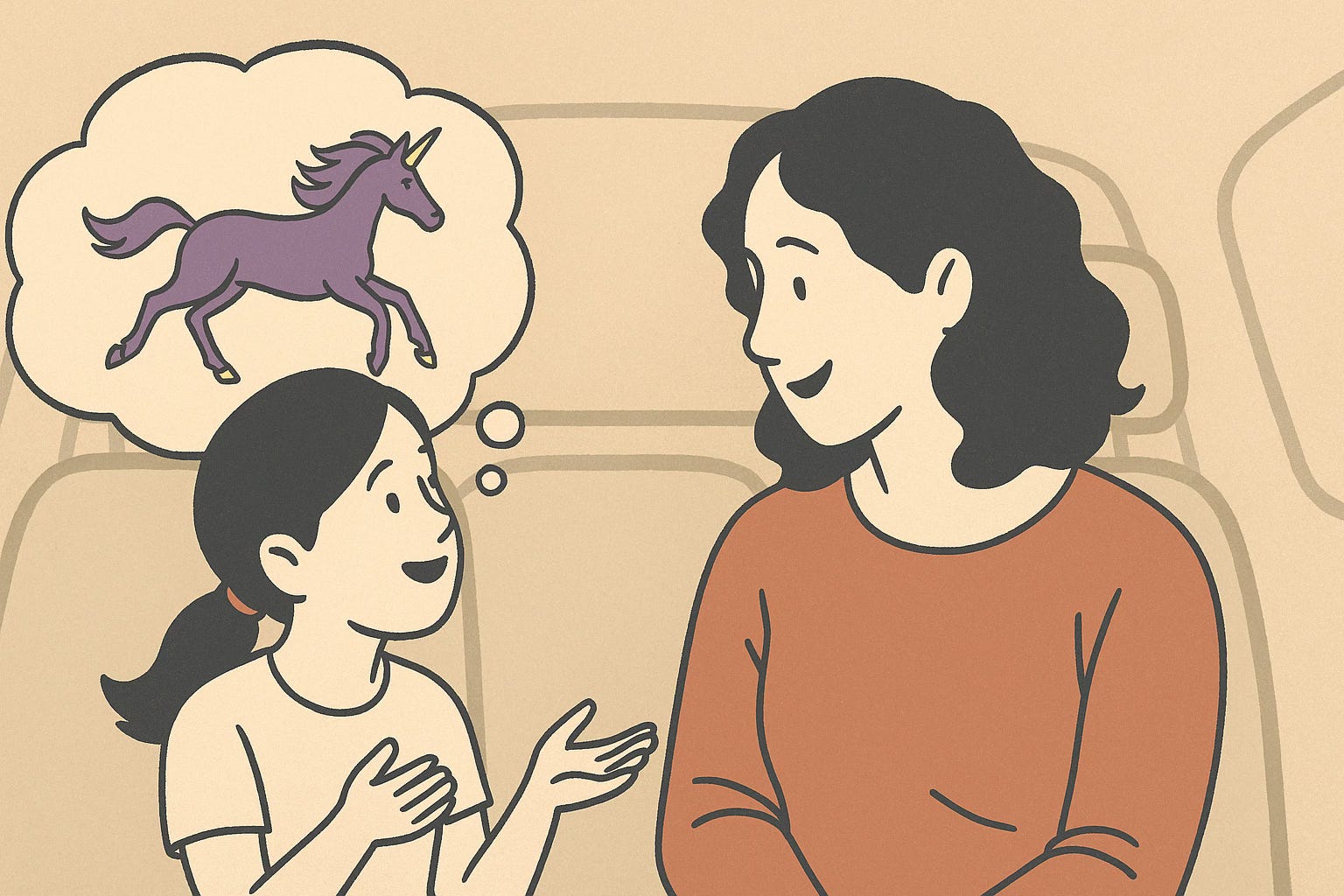
My daughter slid into the car after art camp, cheeks still flushed, fingers smudged with clay. She leaned back, kicked off her shoes, and with a tired grin said, “That was a gallop.” I didn’t ask if she had fun. I didn’t ask what she made. I simply asked, “What made it a gallop?”
Her story tumbled out—wild colors, a new friend, a sculpture saved just in time. That single moment became a way into memory, into meaning.
There’s a rhythm to these moments—soft and fleeting. A car door shuts. A juice box appears. The day hasn’t reset yet. And for a brief window, a child is open. Not to interrogation, but to a quieter kind of noticing: reflection disguised as story. It’s a moment we’ve learned to meet with care. We call it a Challenge Interview, though it feels more like a ritual.
Before the age of abstraction, kids don’t separate learning from joy—they experience growth as motion. A gallop in the brain often feels like laughter or surprise. A canter might bring the comfort of momentum. A walk, the drag of disinterest. But while they can feel it, they don’t yet have the language to explain what happened inside.
Conversely, we often confuse growth with progress—something measurable, quantifiable, and rewarded. But for kids, growth frequently hides inside moments that feel chaotic, playful, or even forgettable until named.
That’s where metaphor begins its quiet work—not as decoration, but as a bridge between sensation and self. Ask a child if they strengthened executive function today, and you’ll get a shrug. Ask, “Was that a walk or a gallop?” The story pours out.
This motion scale—walk, trot, canter, gallop—lets children narrate their experience without assigning value. A gallop isn’t better than a walk—it simply moves faster, lands deeper, and leaves the child more breathless than before. That’s the real purpose of metaphor here: not to rate the day, but to give shape to how it was lived.
When a child can name their speed, they’re not measuring performance—they’re narrating presence, the kind that marks the start of selfhood.
The Challenge Interview is a 20-minute ritual designed for kids ages 7 to 12—that fleeting phase when identity is in motion, thought begins to take shape, and emotion hasn’t yet learned to hide. It’s a sweet spot—the moment when story begins to rise from within, and a child reaches for the thread of who they’re becoming.
This isn’t a toddler bedtime chat. And it’s not a teen vent session. It lives in middle childhood, when patterns begin to rise, and the self begins to take root.
The practice unfolds in four distinct but fluid steps. The first is the Metaphoric Rating: “What speed was that?” The child picks a pace: walk, trot, canter, gallop. That single word opens a door. It pulls story from sensation.
Next is the Pivot Point: “What made it a canter?” This is where specificity surfaces—the stuck moment, the unexpected delight, the turning point they didn’t see coming.
Then comes the Socratic Follow-Up: “Who helped?” “What was hard?” “What surprised you?” Here, we stay grounded in the concrete. We avoid “why,” not because it’s taboo, but because abstraction outpaces what this age is built to carry. The strength is in what happened, not why it happened.
Finally, we land in Emotional Framing: “What did you learn?” “What would you do differently next time?” These aren’t evaluation questions. They’re narrative ones. You’re not asking them to justify. You’re handing them the pen.
This isn’t talk—it’s groundwork.
It’s not recall—it’s identity in construction.
Kids won’t thank you for helping them build narrative identity. They’ll groan. Shrug. Pretend to be asleep. But if you stay with it, something shifts: how they begin to carry the day.
You’ll hear it in a single sentence:
“I think I walked through most of it, but then galloped during the presentation.”
Or: “I cantered through most of it, but I lost focus when we had to wait too long.”
They aren’t just recounting the day—they’re beginning to trace the arc of their own engagement: what stretched, what clicked, and what quietly overwhelmed.
The metaphor becomes a compass. And once that compass starts turning in their hands, they begin to recognize something rare: that reflection isn’t something adults do to them. It’s something they do for themselves.
And if you’re new to this practice and unsure how to invite that kind of internal ownership, you don’t need a script—you need rhythm.
Begin small. A single moment. A shared snack. A question wrapped in metaphor.
“Was that a walk or a gallop?”
If they say “I don’t know,” guess together. Keep it light.
Let the metaphor reflect the world they already know by heart. Horses work. So does water. What matters isn’t cleverness—it’s familiarity.
If you're not a horse person, don’t worry—walk, trot, canter, and gallop are just the speeds of ponies, unicorns, and kids whose brains are on the move.
No wisdom required—just space to wonder aloud, even if it comes out sideways.
The goal isn’t to extract meaning. It’s to offer a form gentle enough for meaning to land.
Once the metaphor lands, the story has a path to follow.
That question is a kind of rebellion in a world of pings and performance dashboards.
It invites a pause in a culture that rushes past nuance.
It says: There’s value in what you felt, not just what you did.
Without rituals like these, experience begins to flatten.
A child may still recount what they did, but not how they felt.
Not what stretched them, or what stuck.
Over time, the habit of noticing fades, and with it, the scaffolding for self-understanding.
The deeper magic sneaks in slowly. One day, unprompted, a child says:
“I galloped in math today—but crashed a little by the end.”
Or: “It was a walk. But I still liked it.”
That’s not a mood swing. It’s the emergence of a mind learning to witness itself.
What you’re hearing isn’t just a story. It’s the earliest form of coherence—a child beginning to place themselves inside the flow of their own life.
That container doesn’t come from us—it forms gradually, shaped by daily noticing.
Reflection, repeated with care, forms rhythm. Rhythm becomes structure. And structure becomes identity, anchored in story.
When reading and reflection braid together, the arc becomes whole.
It’s no longer just about narrating the day. It becomes a way of locating the self inside experience, and doing so over time. That’s where identity takes root—not in the moments we curate for them but in the ones they learn to name.
And right now, the windows for reflection are shrinking.
Children are growing up in timelines, notifications, and fragmented narratives.
To offer them rhythm is to offer them refuge.
Every walk, trot, canter, or gallop is a clue. A marker of motion. A reflection of engagement.
When children learn to narrate their movement through the day, not just in what they did, but how they felt as they moved, they begin to understand something essential:
Not just “Did I succeed?”
But: “Where was I in this?”
And when that kind of reflection becomes a rhythm—when they begin to carry it without prompting—you’re not just raising someone who remembers the day.
You’re raising someone who can shape it and own the words.
Especially now, when algorithms drown voices, identity gets flattened into profiles.
What you’re building isn’t just a moment of connection.
It’s a muscle for coherence in a fractured world.
That’s when narration begins — quietly, with practice.
One metaphor.
One memory named.
One gallop toward a self they can begin to hold.
.